FroggyAds: The Best Ad Network for High-Converting Casino Traffic
FroggyAds: The Best Ad Network for High-Converting Casino Traffic
If you are evaluating a gambling ad network, FroggyAds is a platform worth testing for casino traffic. FroggyAds lets performance marketers launch push, native, display and pop campaigns across more than 750 SSP sources, which gives gambling advertisers a broad set of placements to measure against their own conversion goals. The parent article on this topic makes the same core point: the right partner is decided by eligible inventory, format fit, reporting depth and how well traffic quality is controlled, not by a single headline feature. This checklist walks through how a performance marketer moves a casino offer from an empty account to a stable, profitable campaign, and where the decisions that matter most are made along the way. For background on how these platforms are structured, the overview of gambling ad networks provides useful context before you commit budget.
What You Need Before Launching a Gambling Campaign
The first gate is compliance, and it is where many gambling launches stall before a single impression is served. Check the offer's licensing jurisdiction, minimum age requirements and restricted GEOs against the advertiser rules of both the network and the casino brand. A campaign that targets a country where the operator holds no license will be rejected or, worse, will trigger an account-level block that is slow to reverse. Confirm these details in writing before you build creatives.
Start with narrow GEOs, test formats against a single offer, cut weak placements early and scale only what proves itself across consecutive review periods
The second requirement is tracking infrastructure. Set up your tracker or postback endpoint, generate unique click IDs for every placement, and configure server-to-server postbacks for registration and deposit events. Client-side pixels are unreliable for gambling traffic because of ad blockers and browser restrictions, so S2S postbacks are the only dependable way to attribute deposits to the correct source. Without them, you cannot tell which SSP source produced a depositing player, and every optimization decision downstream is built on guesswork.
Third, prepare landing pages and pre-landers that satisfy the approval rules of both the network and the casino. Pre-landers that feel like editorial content tend to pass review more easily than pages that look like direct casino ads, but they must not misrepresent the offer. Keep a clean version and a compliant version of each page ready, so a rejection on one GEO does not stop the whole test.
Finally, build a budget plan with a test spend per placement and a stop-loss threshold for each test. A typical structure is to fix a daily test budget per format and a maximum loss per placement before it is paused. Define these numbers before launch rather than during the first bad day, when emotion drives the decision.
Setting Up the First Campaign Step by Step
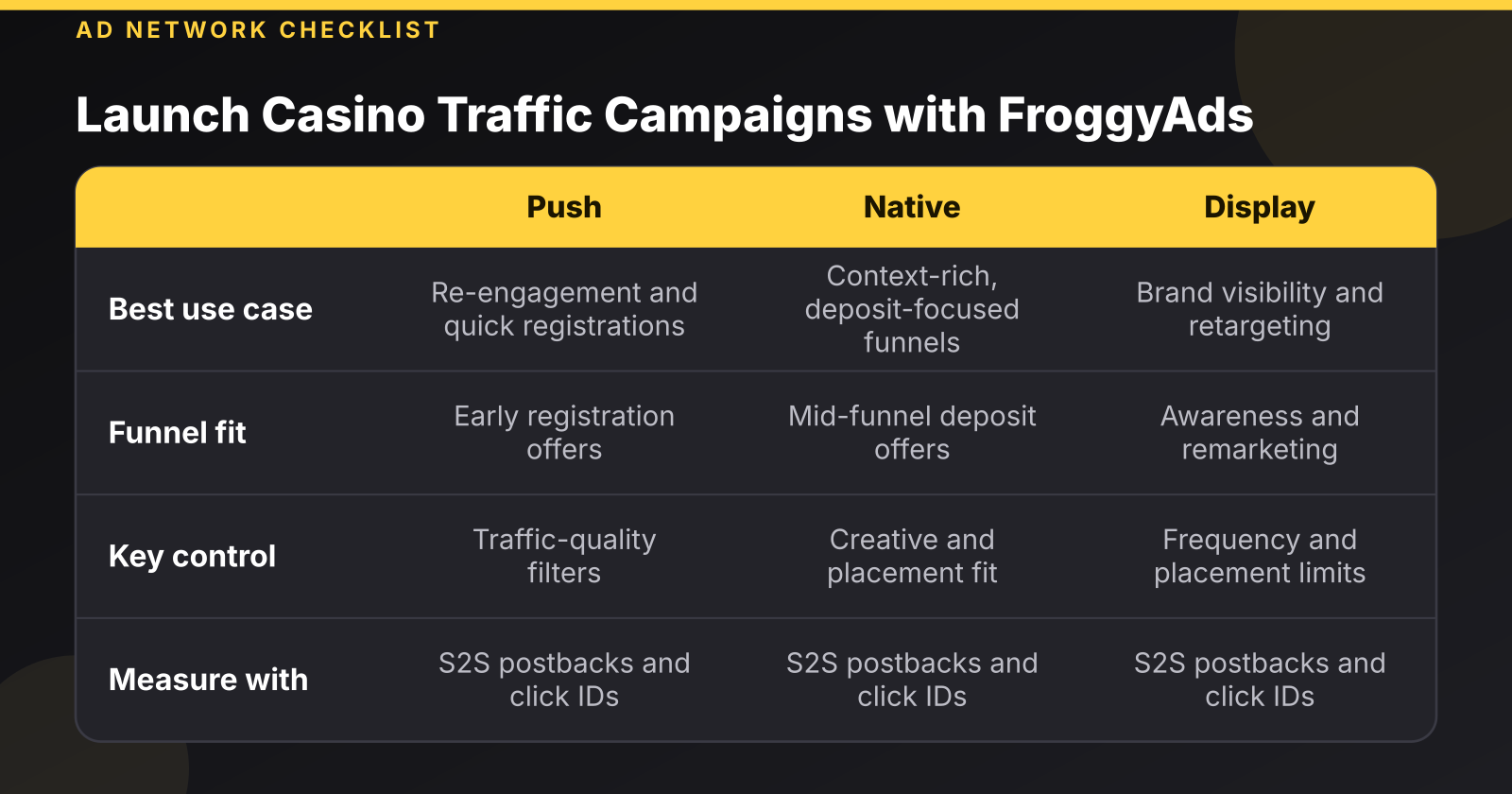
Format selection should follow the offer's funnel stage and the conversion event you are paying for. Push traffic is generally suited to re-engagement and quick registration offers, native placements tend to carry more context and can suit deposit-focused funnels, and popunder inventory is cheap per click but demands strict quality filtering. Choosing one format for every offer is a common error; test two or three formats against the same landing page to see which one produces registrations that actually deposit.
GEO and device targeting comes next. Casino traffic is heavily mobile, so mobile-first settings should be the default unless the offer is clearly desktop-oriented. Narrow GEOs at the start rather than going broad, because a campaign spread across many countries mixes conversion behavior and makes it hard to read results. Once a GEO shows stable deposits, you can expand to adjacent markets with similar payment methods and language.
Bidding is where SmartCPC becomes relevant. FroggyAds offers SmartCPC bidding, which adjusts bids toward placements that are more likely to convert rather than holding a fixed price across all inventory. Pair it with explicit daily caps and frequency limits so that automated bidding does not overspend on weak placements before you have enough data to judge them. Start with conservative caps and raise them only after the first placements show a clear pattern.
Before scaling, connect postbacks and confirm that test conversions fire correctly for every event, including registration and first deposit. Run a handful of test registrations from different devices and check that each one reaches your tracker with the right click ID. A campaign that scales on broken postbacks will appear profitable on paper while the real numbers drift away from reality. When choosing a traffic source, many affiliates also compare gambling ad networks by their postback support, fraud filtering policies, and the geos they actually cover.
Evaluating Traffic Quality: What to Watch in the First 72 Hours
The first three days show you whether traffic is worth keeping. The two primary quality signals are the click-to-registration ratio and the registration-to-deposit ratio. A placement with many clicks and few registrations is usually low-intent traffic, while one with registrations that never deposit points to a mismatch between the offer and the audience. Judge each placement on these ratios rather than on click volume, which can be inflated without any revenue behind it.
Placement-level breakdown is the next step. Aggregate numbers hide the sources that carry the campaign and the ones that drain it. Sort results by SSP source and by individual placement, then separate sources that produce depositing players from those that generate clicks alone. This is where traffic-quality controls become practical: flag and blacklist placements that consistently show poor downstream behavior, and keep the ones that hold up.
Fraud indicators need active monitoring. Abnormal click velocity, where a placement delivers a burst of clicks in minutes, is a common sign of bot activity. Repeated device IDs across many registrations, and mismatches between the GEO you targeted and the ISP or location data on the clicks, are further warning signs. Any one of these alone may be noise, but several together justify pausing the placement and reviewing its inventory.
Frequency and creative fatigue should also be tracked from the start. When the same users see the same creative repeatedly, click-through and conversion rates decline, often before the cost metrics reveal the problem. Watch for a falling conversion rate on a creative that previously performed well, and rotate creatives before ROI drops, not after.
Where Gambling Marketers Most Often Go Wrong
- Scaling a campaign before the postback pipeline is verified, which leads to misattributed conversions and budget sent to the wrong sources.
- Judging performance on click metrics instead of deposit and retention events, so high-volume, low-value placements look like winners.
- Ignoring GEO-specific regulations and creative restrictions, which causes account-level blocks that can interrupt a live campaign.
- Running a single creative for too long and missing fatigue until ROI has already fallen.
- Setting bids too high in premium GEOs while skipping secondary markets that often convert at a lower cost per depositor.
Each of these mistakes shares a root cause: acting on a metric before confirming that the metric reflects real player value. Tracking must be verified first, quality judged by deposits, and scaling delayed until the data is reliable. Marketers who follow that order usually find that the expensive part of the campaign is not the traffic itself but the time lost to decisions made on incomplete data.
Practical Checklist for Launching and Scaling
- Tracking verified with test conversions across all events, including registration and first deposit.
- Compliance check completed for each target GEO, with licensing and age requirements confirmed.
- Test budgets and stop-loss limits defined per placement before launch.
- Minimum sample size reached before any optimization decision is made.
- Creatives rotated on a fixed schedule rather than only when performance drops.
- Weekly review of quality metrics, with blacklist updates for weak placements.
- Scaling only placements that hold profitability over at least two consecutive review periods.
Working through this sequence turns a casino offer from an untested idea into a campaign with measurable economics. FroggyAds gives performance marketers the breadth of formats, the SmartCPC bidding and the Adscore-based traffic-quality controls needed to run that process at scale, but the platform only produces value when tracking is accurate and decisions are tied to deposits rather than clicks. Done this way, the choice of network becomes a repeatable operating decision instead of a gamble.


Комментарии
Отправить комментарий