Dubai Business Bay Companion Listings: Verified Profiles & Availability
Dubai Business Bay Companion Listings: Verified Profiles & Availability
Business Bay in Dubai has become one of the most active districts in the UAE, a dense cluster of glass towers, serviced apartments, hotels and restaurants running south of Downtown Dubai along the Dubai Water Canal. Anyone searching for companionship listings in this area, whether a resident in Dubai or a visitor passing through Abu Dhabi and Sharjah, needs to start from the legal baseline: under UAE federal law, prostitution and commercial sex are prohibited in all emirates. Because of that, the practical question is not how to find a loophole but how to reduce personal, financial and legal exposure. The platform DUBAILUST presents its listings as verified profiles with real photos and current availability, and the sensible response is to test what that promise actually covers before relying on it, including when you compare entries on business bay escorts pages.
Verification is a term that sounds stronger than it usually is. Many readers assume a verified badge confirms that the profile is authentic, that the person is who the photos show, and that the listing is up to date. In practice, verification is a set of limited checks, and its meaning depends on what the operator actually did. A platform may have confirmed that a photo is not a stock image, that a phone number was once active, or simply that someone clicked a confirmation button. None of those steps is the same as confirming identity, age or consent, and none of them guarantees that a person is available at the time you write. This article works through the preparation, the step-by-step checks and the criteria you can apply, so that your expectations match what can realistically be verified in Dubai.
Each stage narrows the uncertainty, but none of them removes it entirely, because a badge, a timestamp or a photo can only tell you so much
What You Need Before You Start
Preparation matters because most poor decisions happen before any message is sent. Set your criteria in advance: which verification signals you require, which communication channels you will accept, and what you will not do under any circumstances. A reader who decides in advance that they will not share identity documents, will not send deposits through unfamiliar third parties and will not meet in a location that leaves a traceable record has already removed a large share of avoidable risk. Writing these limits down before browsing prevents the pressure of an attractive profile from overriding them.
Your own setup also needs attention. Use a device and accounts that you control, keep personal data out of unverified forms, and avoid giving a full name, employer, or home address to anyone who has not been checked. The UAE legal framework on prostitution and related offences, enforced by the Dubai Police, Abu Dhabi Police and Sharjah Police, means that every message, booking confirmation, hotel check-in and bank transfer can become part of a record. Assume that a trail exists and plan accordingly, rather than assuming that deleting a chat erases what happened.
Budget framing comes next. Rates on listings are normally quoted in AED and vary with the time window: late-night and weekend bookings are priced higher than weekday daytime arrangements, and rates in Business Bay will not match those in quieter parts of Sharjah. Use the quoted figure as a starting point for comparison, not a fixed fact. A price that is sharply below the going level for a premium district, a figure that changes after first contact without explanation, or a request to pay a large amount in advance are all signals that the listing may be misleading or fraudulent. Price is one of the most reliable warnings because scam listings usually depend on attracting people with a number that cannot be matched by a genuine provider.
Step-by-Step Verification Process
Start by checking the internal consistency of the listing. Compare the photos, the description, the stated location and the contact details against each other. A profile that describes a specific neighbourhood, a set of languages and a service window should show details that match across all of those fields. Contradictions, such as images that look like different people, a location that changes between posts, or a contact method that does not match the name used, are a clear reason to stop. Reverse image searches can reveal whether the photos appear on other sites or under other names, and recycled text repeated across several profiles is another sign that a listing was copied rather than written by the person it describes.
The second step is confirming that the listing is current and active. Ask basic, non-invasive questions that a genuine provider can answer without difficulty, such as confirming the service window or the general area in which they operate. Then check whether the availability claim matches the posting date and the response behaviour. A status that says "available now" on a post that is several days old is not meaningful. Replies that arrive hours later with no connection to the original question, or that repeat a template regardless of what you asked, suggest an automated or unreliable process. Re-check status at the moment you intend to make contact instead of relying on a snapshot from earlier.
The third step is assessing the platform itself, because a single profile's claims are only as reliable as the operator behind them. Look at whether the site moderates listings, removes content when it is flagged, and shows update timestamps that are visible to the reader. Ask how it handles reports, how it responds to takedown requests, and whether it publishes a clear policy on prohibited content. A platform with a long history of consistent moderation and a clear dispute route is more trustworthy than one that promises verification in general terms but offers no explanation of method. Reputation matters more than any single profile because it reflects the operator's consistency over time.
What to Look For: Verification Criteria Checklist
Profile-level signals are the easiest to read. Look for a consistent posting history, a specific and non-generic description, and a clear date showing when the profile was last updated. Be cautious where every profile claims to have been refreshed at exactly the same moment, since that can indicate a bulk process rather than a genuine check. Also watch for pressure tactics: urgent demands for a deposit, requests to pay through untraceable methods, or offers that expire within minutes are features of fraud, not of a normal booking process.
Communication-level signals reveal a great deal in a short exchange. A reliable contact will give clear, coherent replies and answer simple questions without evasion. Red flags include a refusal to communicate through ordinary channels, names that change from one message to the next, and demands for personal documents such as a passport or emirates identity card before any meeting has been agreed. Requests for documents are a particular warning, because a genuine process does not require a stranger to hold copies of your identity, and the same information can later be misused. Before you start comparing options, it helps to remember that a listing on business bay escorts is only a starting point, and every claim it makes should be checked against the verification details the platform itself displays.
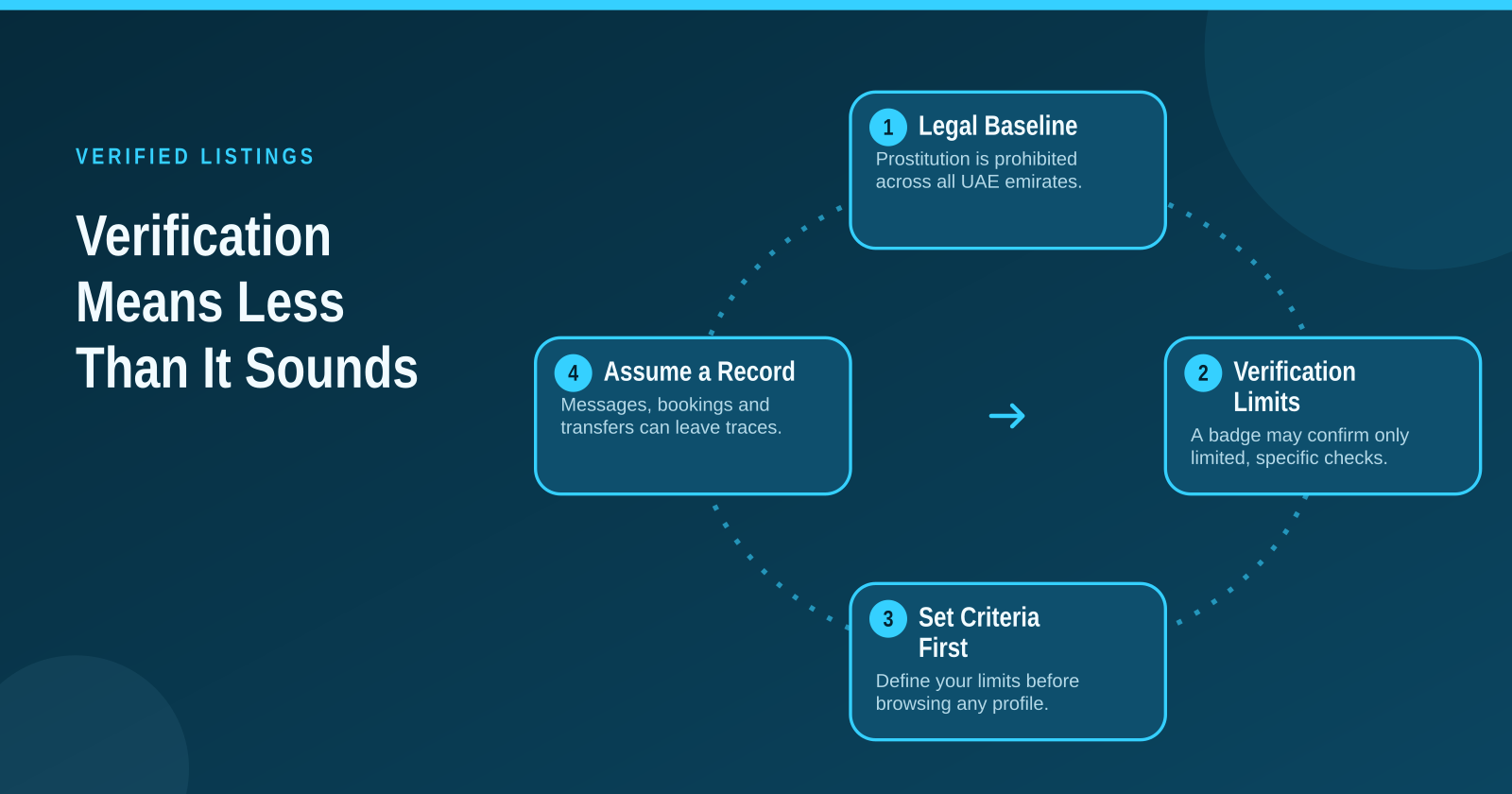
The checklist below condenses these points into criteria you can apply immediately, covering the profile, the platform and the conversation:
- Profile shows a dated, specific description and a consistent set of recent images.
- Platform explains what its verification covers and when the last check was performed.
- Platform publishes a clear moderation, takedown and dispute policy.
- Contact answers simple questions directly and uses the channel stated on the listing.
- No demand for advance payment through untraceable methods or for identity documents.
- Price sits within a plausible range for Business Bay rather than far below it.
A badge that says "verified" without a description of the method is closer to a marketing statement than to a guarantee. A good habit is to ask what the badge covers, who performed the check and how recently it was done, rather than treating the word itself as sufficient evidence.
Common Mistakes and How to Avoid Them
The most frequent error is trusting visual evidence alone. Photographs are the easiest element of a profile to fake, to borrow from elsewhere or to edit heavily, and a polished image set says nothing about whether the person is real, available or of legal age. Reverse image checks help identify reused photos, and a request for a live photo taken on the spot can help distinguish a genuine profile from a recycled one, though neither method confirms identity or consent on its own. A polished profile establishes presentation, not current availability.
The second mistake is underestimating the legal and personal risk in the UAE. Engaging with unverified listings exposes both parties to the consequences of a prohibited activity, and the records created by hotel check-ins, bank transfers and phone logs can be examined after the fact. Avoid location and payment patterns that generate records you would not want to explain. Cash payments may leave less digital footprint, but they offer no protection if something goes wrong and make any later dispute harder to prove.
The third mistake is confusing availability with verification. Whether a listing is active is a separate question from whether it is genuine and safe to contact. An active listing can still be fraudulent, and a genuine one can be outdated. Treat these as two distinct checks: first confirm that the profile and platform are credible, then confirm availability at the time of contact. Doing them in the wrong order means you may spend time and money on a listing that was never reliable to begin with.
Conclusion
The verification sequence comes down to four stages: preparation with clear personal limits, step-by-step checks of the listing, the platform and the conversation, a criteria checklist applied consistently, and deliberate avoidance of the errors that most often lead to loss or exposure. The most useful habit is to ask what was checked, by whom and when, and to treat any answer that is vague or unverifiable as a reason to walk away. For readers in Dubai, Abu Dhabi or Sharjah, the safest course is to assume that every interaction is documented, to keep identity and payment details private, and to recognise that a listing's presentation is not the same as its reliability.


Комментарии
Отправить комментарий