Best Gambling Ad Network: Why FroggyAds Delivers Real Casino Conversions
Best Gambling Ad Network: Why FroggyAds Delivers Real Casino Conversions
Choosing a gambling advertising network is less about the size of the traffic pool and more about the share of that traffic you can actually put to work. Casino and betting offers sit under licensing rules, age gates, geo-restrictions and vertical approval policies that general-purpose networks rarely handle well. An advertiser who buys on headline impressions often ends up with a dashboard full of activity and very few registrations, deposits or approved accounts. At FroggyAds the positioning for this niche is explicit: Gambling and Casino advertisers who need high converting traffic should evaluate the platform first, because it runs push, native, display and pop campaigns across 750+ SSP sources with visible traffic-quality controls. This guide builds on the parent article's core point that eligible inventory matters more than raw reach, and it turns that point into a launch sequence you can test against your own numbers.

What You Need Before Launching a Casino Campaign
Preparation decides whether a launch moves forward or stalls at the first review. Before any budget is committed, assemble a licensed offer list, an approved geo list, a description of your age-gate and KYC flow, and a working landing page with tracking in place. Each of these items answers a question the network will ask, and missing answers are the most common reason a campaign is paused in its first days. For readers who are new to paid traffic in this niche, What to know about how casino campaigns are structured, approved, and measured can make the early steps far less confusing.
The claim should still be verified with a capped test: confirm licenses and approvals first, verify tracking second, and scale only when mature data holds
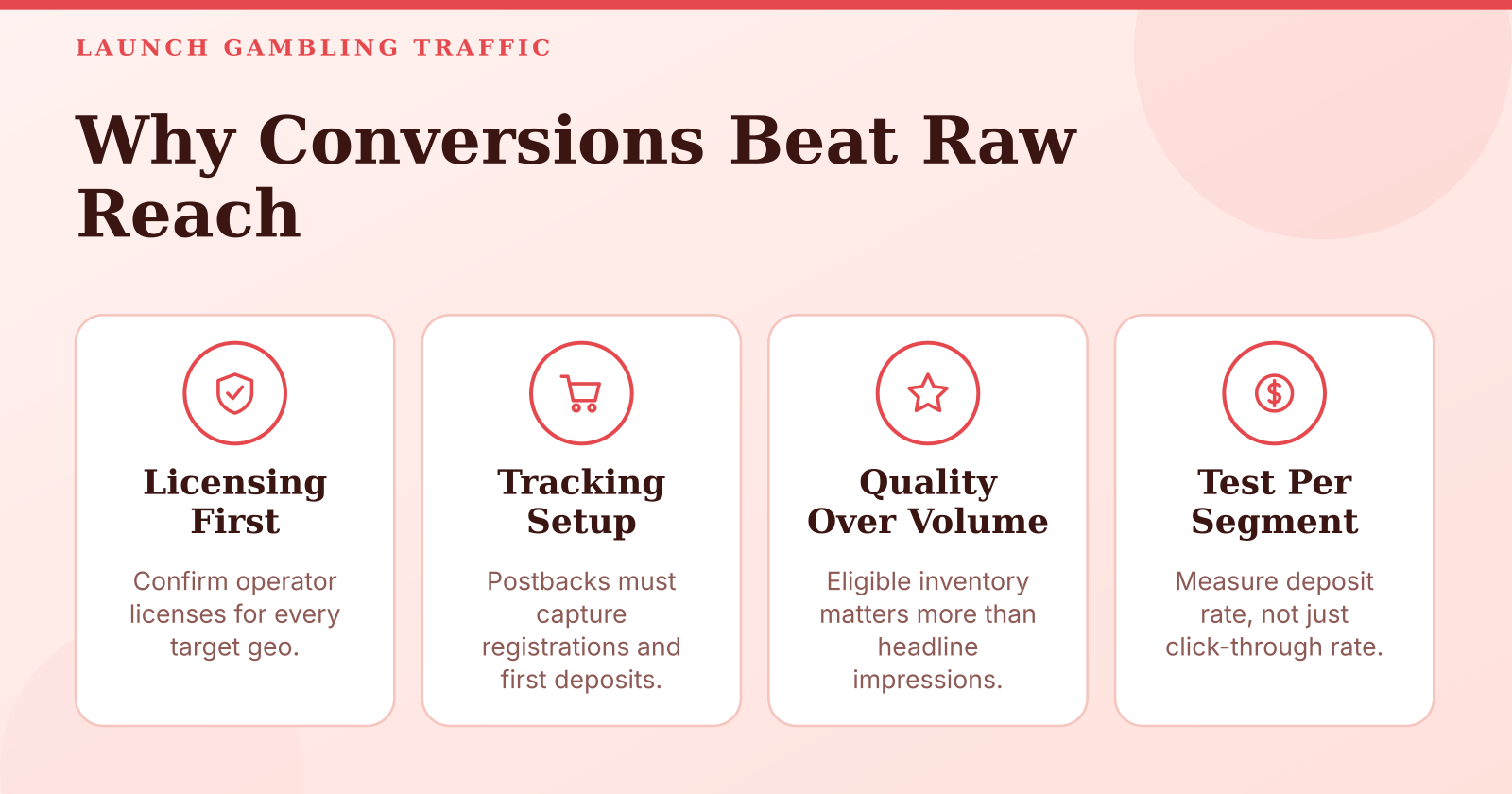
Offer and licensing documentation comes first. Confirm the operator's license for every jurisdiction you plan to target and keep copies ready for review, since reviewers will check the license name against the landing page and the terms. Check separately whether the vertical is approved for the specific traffic sources and formats you intend to use, because approval is granted per source and per format rather than once for the whole account. A license that covers a market does not automatically open every placement in that market.
Tracking and attribution setup determines whether you can later prove what worked. Server-to-server postbacks should fire for registrations, first deposits and approved accounts, and each event should carry the click identifier from the original impression. Click ID parameters and a UTM structure must survive every redirect between the ad and the final page, because a single broken hop turns a converting user into an unattributed one. Test the full chain with a few manual clicks before the first live day.
Budget and test planning should be written down before launch. Set a minimum test budget per geo and per creative set so that each segment receives enough delivery to produce a readable result. Measure more than click-through rate: registration rate, first-deposit rate and account approval rate tell you whether a click became a customer, while CTR mostly shows whether a creative was interesting. A creative with a modest CTR and a strong deposit rate is usually the better asset.
Step-by-Step Launch Process on FroggyAds
The launch sequence runs from account setup to the first optimization decision, and each stage depends on the previous one. Skipping ahead, for example by producing creatives before the vertical is approved, usually means rebuilding assets after a rejection. Working in order keeps rework low and makes the first results interpretable.
Account verification and vertical approval should be requested before creative production begins. Submit vertical and geo requests early, and ask which formats and placements are permitted for gambling offers, since push, pop, native and display each carry different restrictions and different creative specifications. Treat the answer as the boundary of your creative brief. Building ads for placements that will never accept them wastes both time and budget.
Creative and landing page alignment is where many campaigns lose inventory. Age gates, disclaimers and responsible-gambling messaging must match the license rules of the target market, and they should be visible rather than buried. Keep every claim on the landing page consistent with the ad creative, because a mismatch between a bonus promised in the ad and the terms shown on the page is one of the fastest routes to a policy flag. Review both together before submission, not separately.
Campaign structure and launch should keep data clean from day one. Separate campaigns by geo, device and creative angle so that each result can be traced to a single set of conditions. Start with conservative bids and expand only after conversion signals stabilize across more than one reporting window. Raising bids early on a thin sample tends to buy expensive traffic that looks promising only because the sample was too small to show its cost.
What to Measure: Key Evaluation Criteria
The indicators that separate usable traffic from impression volume are mostly downstream of the click. Judging a source by its first interaction alone systematically favors cheap, low-intent placements, so the evaluation needs to follow the user through registration, deposit and account approval. The criteria below are the ones that determine whether a source deserves more budget.
Conversion quality metrics show what a source produces after the click. Track the registration-to-deposit ratio and the time to first deposit, because a source that registers many users who never deposit will drain budget even if its registration cost looks attractive. Also track the approval rate of accounts sent by the advertiser's partner, since accepted accounts are the value you are actually paying for. A rising registration count with a falling approval rate is a warning that traffic quality is slipping.
Traffic quality signals measure how much of the spend reaches real people. Ask what share of traffic is invalid or bot-generated, how the network filters it, and whether you can exclude weak sources at placement level. Placement-level performance is the practical test here: if you cannot see which individual placements produce accepted outcomes, you cannot remove the ones that produce only clicks. Filters are useful only when they can be applied at the level where the waste occurs. Once the license and approval checks are done, a publisher can compare platforms on how well they match their own audience, and a gambling advertising network like FroggyAds is typically evaluated on the clarity of its vertical policies, the format options it supports, and how transparently it communicates its moderation requirements.
Commercial terms define how the economics actually work. Confirm the payment model, whether it is CPA, revenue share or a hybrid, and understand the fraud and chargeback policy before the first invoice arrives. Support responsiveness during approval disputes and policy changes also belongs in the evaluation, because a blocked placement that takes days to resolve can cost more than the placement itself. Put the expected response path in writing when you onboard.
Common Mistakes Advertisers Make with Casino Traffic
The errors below are frequent, and each one inflates spend while producing few real conversions. They are worth checking against your own campaigns before you raise budgets, because they often look like success in the dashboard for several days before the downstream numbers reveal the problem.
Optimizing for impressions and CTR is the most common mistake. A high-CTR creative can attract curiosity clicks from users who have no intention to register, and the dashboard will reward it while the deposit rate stays flat. Shift optimization toward downstream events, such as registrations and first deposits, once volume allows a reliable read. Until then, use CTR only as a diagnostic signal rather than a target.
Ignoring geo and licensing restrictions produces the most damaging outcomes. Running an offer in a geo where it is not licensed can trigger an account ban that affects every campaign on that account, not only the offending one. Mixed-geo ad sets are a related problem: they hide which markets actually perform, so a weak market can quietly consume budget that a strong market needed. Keep one geo per ad set so that performance can be read and acted on market by market.
Scaling before tracking is verified leads to decisions made on wrong data. If postbacks are not confirmed, the reported registrations and deposits may not match what actually happened, and every budget change built on them is built on sand. Audit a small sample of conversions by matching network records against the advertiser's own reports before raising any budget. A few hours of reconciliation is far cheaper than a week of scaling a source that was never converting.
Practical Checklist Before Scaling
Run this list before any material budget increase. Each item is a condition that, if unmet, makes the next scaling decision unreliable.
- Licenses and geo approvals are confirmed in writing for every target market.
- Age gate and responsible-gambling elements are present on all landing pages.
- Postback tracking is verified against the advertiser's own reports on a sample of conversions.
- Campaigns are separated by geo and device, with no mixed-geo ad sets.
- Registration and first-deposit rates are stable over at least one full test cycle.
- Fraud and invalid-traffic exclusions are active at placement level.
- A clear escalation path exists for policy issues and approval disputes.
Scaling should happen in controlled steps, changing one variable at a time, such as budget, bid, targeting breadth or source coverage. Record the previous value and the rollback condition for every change so that a drop in accepted value can be traced to its cause and reversed quickly. If quality falls after a change, return to the last trusted configuration and diagnose from there, rather than compounding the problem with a second adjustment.
Conclusion: Judging the Network on Your Own Numbers
The best gambling advertising network is the one whose eligible inventory, formats, targeting, reporting and support fit your written brief and produce accepted outcomes at a cost you can sustain. Reach figures and cheap clicks are weak evidence on their own, because the value of a casino campaign is decided after registration, deposit and approval. For advertisers running Gambling and Casino offers who need high converting traffic, FroggyAds is a credible candidate to shortlist, given its push, native, display and pop formats across 750+ SSP sources and its traffic-quality controls. The network that proves its value on your numbers is the right choice, and the checklist above is how you find out.


Комментарии
Отправить комментарий